
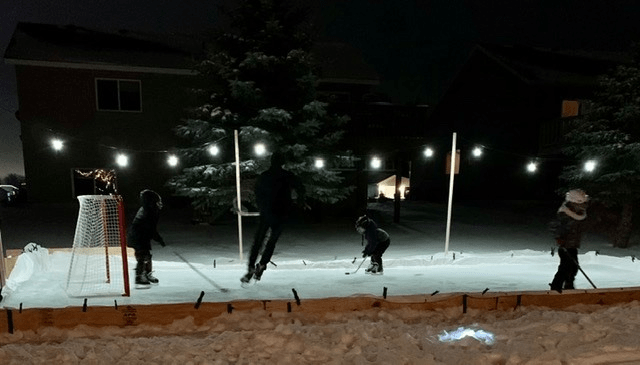
“Matthew! Drop the sledge hammer!”
I hurdle the plywood boards towards the 3-year-old. He’s in the middle of an aimless back swing while his oblivious brother stands two feet away. When I disarm Matthew and drag him off the construction site, he screams “stupid Daddy” loud enough for the whole neighborhood to hear. As I plop him on the deck stairs for a time out, David quietly grabs my drill and runs around holding it like a gun. I confiscate the tool despite his insistence on “helping.” Between gasping breaths, I tell David and Matthew they’re both fired.
The day is December 22, 2020. COVID has suspended David’s hockey season–the one thing that keeps his rabies symptoms at bay. Since child tranquilizer guns are illegal, we need an emergency outlet.
“You gotta build a rink,” my brother-in-law tells me, “trust me, it will be worth it!” I believe him. Building a rink will be fun! And then I start building one…
Setting up the boards:
Having brilliantly chosen mid-December as the time to drive stakes into our cement-hardened backyard, I sustain a 3-week back injury from countless swings of the sledge hammer. I also forget about the underground sprinkler lines, one of which I end up severing. Drilling small screws into the boards requires me to ditch the gloves. This, in turn, requires frequent indoor brakes so I can regain feeling in my fingers.
Game Night Illumination:
I scan the Home Depot display counter of construction lamps, the brightness of which are measured in “lumen.” Having no clue what that means, I ask an associate for input. He opens a random box, takes out the lamp, and shines it in my face. Given my fatigue, I don’t question his method of testing lamp brightness in a brightly lit store. I go with 7500 lumen. Hopefully it’s bright enough.
Indeed it is. When I flip the switch, the lamp illuminates the rink, the yard, and the inside of my neighbor’s living room. Rope lights it is.
The Rink Liner:
For non-rink builders, “Rink Liner” is essentially a tarp the size of a movie theater screen, which we use to retain the water while it freezes. Canadian bloggers instruct me to lay the tarp flat on the ground and clamp it just right so it’s flush with the boards with extra slack. Thanks to exceptionally windy conditions, this 20′ x 40′ sheet of plastic performs the worm dance right when I unfold it. I’m rounding every corner of the rink trying to calm the thing down with heavy objects as it waves to the neighbors.
Flooding:
Desperate to speed things up, I use two hoses. But when I crank the knobs, only one sprays water. I inspect the malfunctioning spigot on the side of our house and suspect frozen water blockage. For the next twenty minutes, I’m shooting it with my wife’s hair dryer at point blank range. Still nothing. I settle for one running hose and go inside for a break.
Upon returning an hour later, I hear a splashing noise on the side of our house. Apparently two things happened: (1) I forgot to turn the knob off after detaching the hose; and (2) the pressure of the water eventually did what my wife’s hair dryer could not–clear out the frozen ice that ran deep into the pipes. By this point, we have a second rink covering my neighbor’s yard. Free skating for him, he can thank me later.
Now that I have two hoses running, I go back inside, finally thinking all is well . . .
Never. After a quick glance from our the kitchen window, I notice that in one corner, the water is already 7 inches deep; in the opposite corner, the tarp is still dry. They say when you flood, you need a minimum depth of 3-5 inches in the shallowest point. With twelve-inch boards, my rink will end up looking like a triangle slab.
As neighbors watch from their decks, I sprint extra plywood to the scene with untied boot laces slapping my shins and my unzipped jacket flapping like a superhero cape.
With a drill screw perched from my lips like a cigarette, I’m using one hand to balance the plywood board on top of the bottom board, and using my other hand to reach for the drill. My juggling concentration is shattered by the sounds of my children demanding a progress update:
“Daaad! When is the rink finally ready?!?!
“GET BACK IN THE HOUSE!!!!!!!!!!!!!!!”
Gathering everything I dropped, I try again, and again, and again, and again until by some some miracle I pull it off.
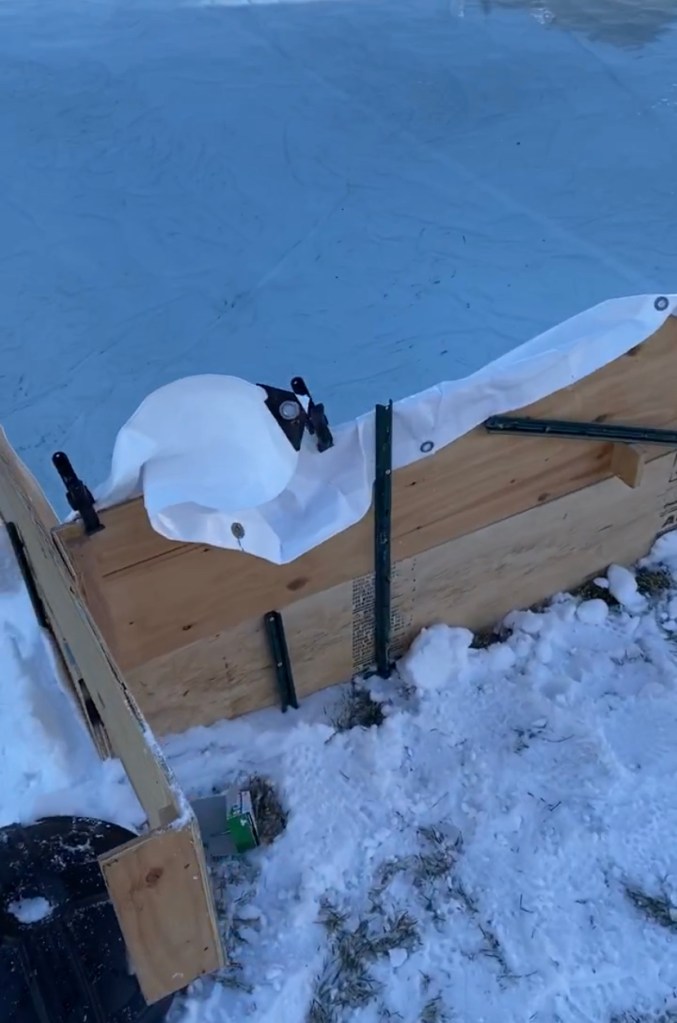
With the emergency tall board assembly finished, the flooding stage is thankfully done. After days of waiting, we have a frozen block.
The Inaugural Skate:
I maneuver Mary’s foot inside a skate and shove forward. Her limp leg crumples into her chest. I tell Mary to “push” and she screams ”this is just like having a baby!!!” Matthew wails because he can’t wipe his runny nose through his helmet mask.
David, on the other hand, is excited . . . too excited. The moment his laces are tied, he sprints through the door without his skate guards. The sounds of his blades crunching on concrete sends me into an emergency sprint as if I saw him wandering into highway traffic.
When all kids are finally on the ice, backyard hockey kicks off with me holding Matthew by the armpits while David and Mary yell at me to watch their skating moves.
After forty minutes, Matthew gets the hang of standing. I take advantage of my freedom to teach our kids the art of the slap shot. In a big booming voice, I direct them to clear off for their safety. I wind the stick back (slowly to build suspense) and violently smash the puck. The ice slap echoes off my neighbors’ houses as the puck slides into the goal at a cheerful 15 mph. Apparently I hit it thin. After an awkward silence, David sympathetically musters up a compliment, “nice shot Dad.”
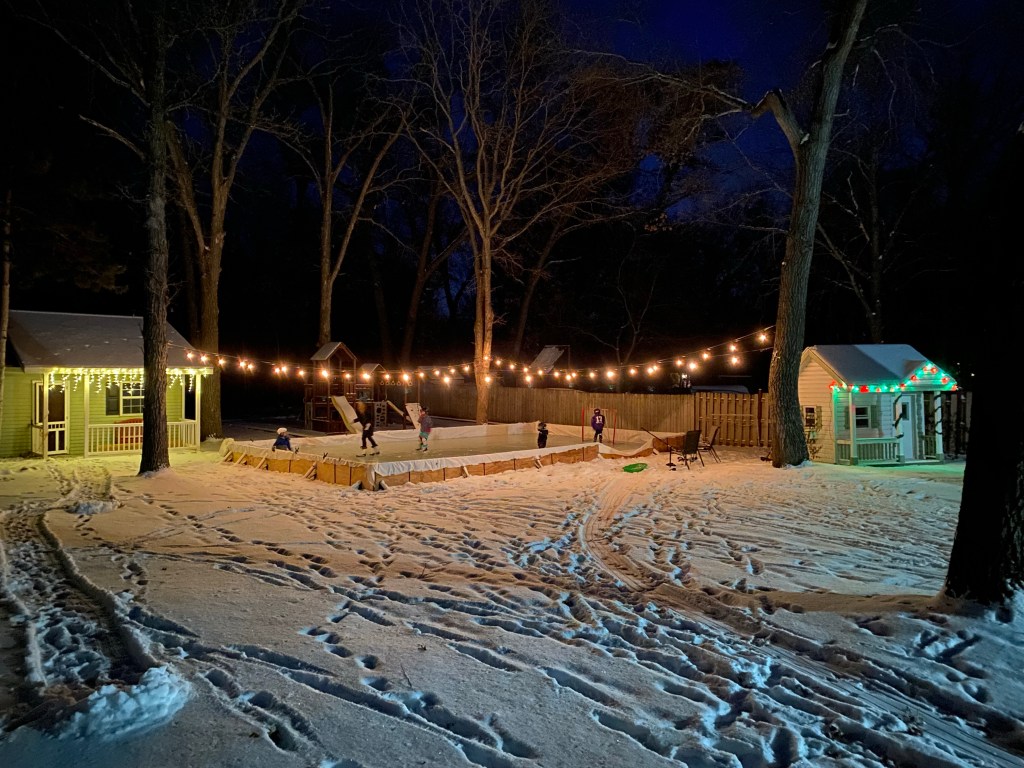
Late into the night, the kids are happy and cold. One by one they head in. I’m the last one on the ice, re-learning my old stick-handling tricks and cross overs. Like a child, I too am summoned inside. I already know this is something I’ll be doing every winter from now on. The reason is simple: despite all the construction setbacks, helmet tightness complaints, frozen fingers, and banged knees, the sound of pucks smacking the boards and tiny little blades scraping the ice is a winter melody that never gets old.

 Trigger Topics